
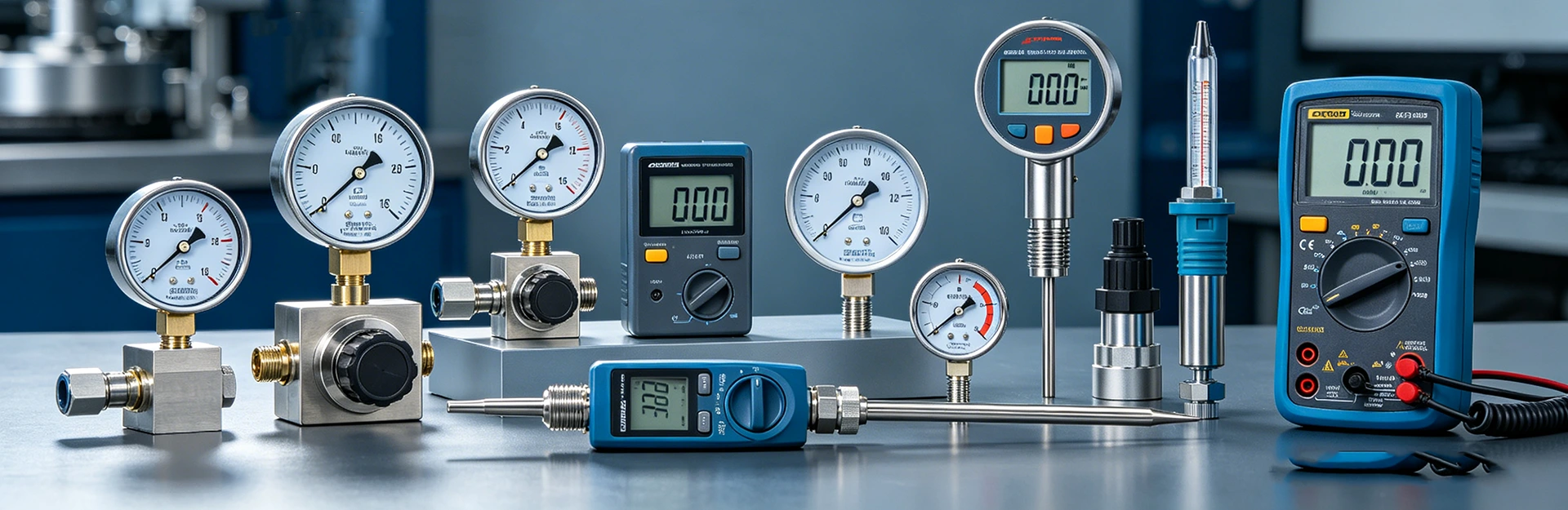
Test Instrument
What is a Test Instrument?
A test instrument is a device or system used to measure, analyze, monitor, or validate the physical properties, electrical characteristics, or functional performance of a component, circuit, or system under test. In industries ranging from electronics manufacturing and telecommunications to automotive development and industrial maintenance, these instruments are the cornerstone of quality control, research and development, and troubleshooting. They provide the quantifiable data necessary to ensure products meet design specifications, regulatory standards, and performance expectations. From verifying a simple battery voltage with a multimeter to performing complex signal integrity analysis with an oscilloscope, test instruments are indispensable tools for engineers and technicians worldwide. The precision, reliability, and capabilities of these tools directly impact innovation, safety, and efficiency.
Core Product Categories & Technical Specifications
At instruments-meters.net, we provide a comprehensive portfolio of professional-grade test instruments. Understanding the key parameters is crucial for selecting the right tool. Below is a breakdown of major categories with detailed specifications presented in both list and table formats for clarity.
1. Digital Multimeters (DMMs)
The fundamental tool for electrical measurement, a DMM combines several measurement functions into one unit.
- Basic Measurements: AC/DC Voltage, AC/DC Current, Resistance, Continuity, Diode Test.
- Advanced Features: Capacitance, Frequency, Temperature, True-RMS for accurate non-sinusoidal waveform measurements.
- Critical Specifications: Display digits/counts, basic DC accuracy, safety category (CAT III, CAT IV), and input impedance.
| Model Series | Display (Digits/Counts) | Basic DC Accuracy | Safety Rating | Key Advanced Functions |
|---|---|---|---|---|
| DM-100 Series | 3½ (2000 counts) | ±0.5% | CAT III 600V | Continuity, Diode, Data Hold |
| DM-200 Series | 4½ (50000 counts) | ±0.05% | CAT III 1000V / CAT IV 600V | True-RMS, Capacitance, Frequency, Temp |
| DM-500 Bench Series | 5½ (2,000,000 counts) | ±0.0025% | CAT I 1000V | Dual Display, Hi/LO Ω, Graphical Trends |
2. Oscilloscopes
Oscilloscopes graphically visualize varying signal voltages, essential for analyzing waveform shape, timing, and noise.
- Types: Digital Storage Oscilloscopes (DSO), Mixed Signal Oscilloscopes (MSO), Portable/Handoeld Scopes.
- Core Parameters: Bandwidth, Sample Rate, Record Length, Number of Channels, Rise Time.
| Model Type | Bandwidth | Sample Rate | Channels | Display & Key Analysis |
|---|---|---|---|---|
| OSC-70 Portable DSO | 70 MHz | 1 GSa/s | 2 Analog | 7" LCD, Auto-setup, 27 Automated Measurements |
| OSC-200 MSO | 200 MHz | 2 GSa/s | 2 Analog + 16 Digital | 10.1" Touchscreen, Serial Decoding, Advanced Triggers |
| OSC-1G Bench DSO | 1 GHz | 5 GSa/s | 4 Analog | 12.1" HD, Spectrum Analyzer, High-Res Mode, Long Memory |
3. Signal Generators & Power Supplies
These instruments provide controlled stimuli for testing circuits and powering devices under test.
- Signal Generators: Create electrical waveforms (sine, square, pulse, arbitrary).
- Power Supplies: Deliver stable, adjustable DC (or AC) voltage and current.
| Instrument Type | Model Example | Key Output Specification | Features & Resolution |
|---|---|---|---|
| Arbitrary Function Generator | AFG-100 | 25 MHz, 14-bit, 250 MSa/s | Built-in waveforms, modulation, USB interface for arbitrary shapes. |
| Programmable DC Power Supply | PSU-3003 | 0-30V, 0-3A, Dual Output | Constant Voltage/Current, Series/Parallel tracking, OVP/OCP protection. |
| Precision Linear Power Supply | LPS-605 | 0-60V, 0-5A | Low ripple (<1mV RMS), 1mV/1mA resolution, GPIB/RS-232 programmability. |
4. Environmental & Specialized Testers
This category includes instruments for testing non-electrical parameters critical to system performance.
- Examples: Insulation Testers (Megohmmeters), Earth Ground Testers, Clamp Meters, Thermometers, Data Loggers.
Test Instrument FAQ
Q: What is the most important safety consideration when using a test instrument?
A: The foremost safety rule is to always use a test instrument rated for the measurement category (CAT rating) of the point in the electrical installation you are testing. For instance, a CAT IV-rated multimeter is designed to withstand voltage transients that can occur at the service entrance of a building, while a CAT II meter is for outlet-level measurements. Never exceed the instrument's maximum input ratings for voltage, current, or power. Always use test leads with proper insulation and finger guards, and ensure the instrument is in good working condition before use.
Q: How do I choose between a multimeter's "counts" and "digits" specification?
A: Both indicate the resolution of the display. "Digits" (like 3½ or 4½) is an older, logarithmic way to describe the range. The ½ refers to a most significant digit that can only be a 1 (or sometimes 2-3). "Counts" is a more direct, linear number representing the total number of values the meter can display. For example, a 3½ digit meter typically has 2000 counts. A higher count number means the meter can resolve smaller changes on a given range, providing more precise readings. When comparing meters, focus on the "counts" for a clearer comparison of resolution.
Q: Why is oscilloscope bandwidth so critical, and how much do I need?
A: Bandwidth is the frequency at which a sine wave input signal is attenuated to 70.7% of its true amplitude (-3 dB point). If your scope's bandwidth is too low, you will see reduced amplitude and lose signal detail, making measurements inaccurate. A general rule of thumb is to select an oscilloscope with a bandwidth at least 3 to 5 times the highest frequency component (not just the fundamental frequency) in your signal. For digital signals with fast rise times, calculate the required bandwidth using the formula: Bandwidth (Hz) ≈ 0.35 / Rise Time (seconds). For a 10 ns rise time, you'd need a minimum of 35 MHz, but 100 MHz or more is advisable for accuracy.
Q: What is the difference between a standard power supply and a precision or linear power supply?
A: A standard switching power supply is efficient and compact but can generate significant electrical noise (ripple) on its output. A precision linear power supply uses a linear regulator to provide an extremely clean, stable output with very low noise and ripple. This is essential for sensitive analog circuits, audio applications, sensor biasing, and laboratory calibration work. Linear supplies are larger, less efficient, and generate more heat but offer superior output quality and faster transient response compared to switching supplies.
Q: How often should I calibrate my test instruments, and why is it necessary?
A: Calibration frequency depends on the instrument's usage, criticality, manufacturer's recommendation, and quality standards (like ISO 9001) you must adhere to. Typical intervals range from 6 months for highly critical lab standards to 2-3 years for general-purpose field tools. Calibration is the process of comparing the instrument's readings to a known, traceable standard and adjusting it if necessary. It is necessary to ensure measurement accuracy, maintain product quality, ensure safety, meet regulatory compliance, and uphold the validity of your test data. Instruments from instruments-meters.net come with a certificate of calibration traceable to national standards.
Q: Can I use a general-purpose multimeter to measure insulation resistance?
A: No, you should never use a standard multimeter's resistance function to measure insulation resistance. Insulation testers (megohmmeters) are designed specifically for this purpose. They apply a much higher test voltage (typically 250V, 500V, or 1000V DC) to stress the insulation and measure the extremely high resistance values (in megohms or gigohms) that indicate good insulation. A standard DMM uses a low test voltage (a few volts) and cannot detect insulation breakdown at operating voltages, which could lead to a false sense of security and serious safety hazards.
Q: Where can I find technical support, manuals, and accessories for my test instrument?
A: For all instruments purchased from instruments-meters.net, comprehensive support is available through our website. You can find downloadable PDF manuals, application notes, firmware updates, and datasheets in the product support section. Our technical support team, staffed by experienced engineers, is available to assist with operational questions, application guidance, and troubleshooting. We also stock a full range of genuine accessories, including high-quality test leads, probes, current clamps, carrying cases, and calibration kits to ensure optimal performance and longevity of your equipment.
- View as