
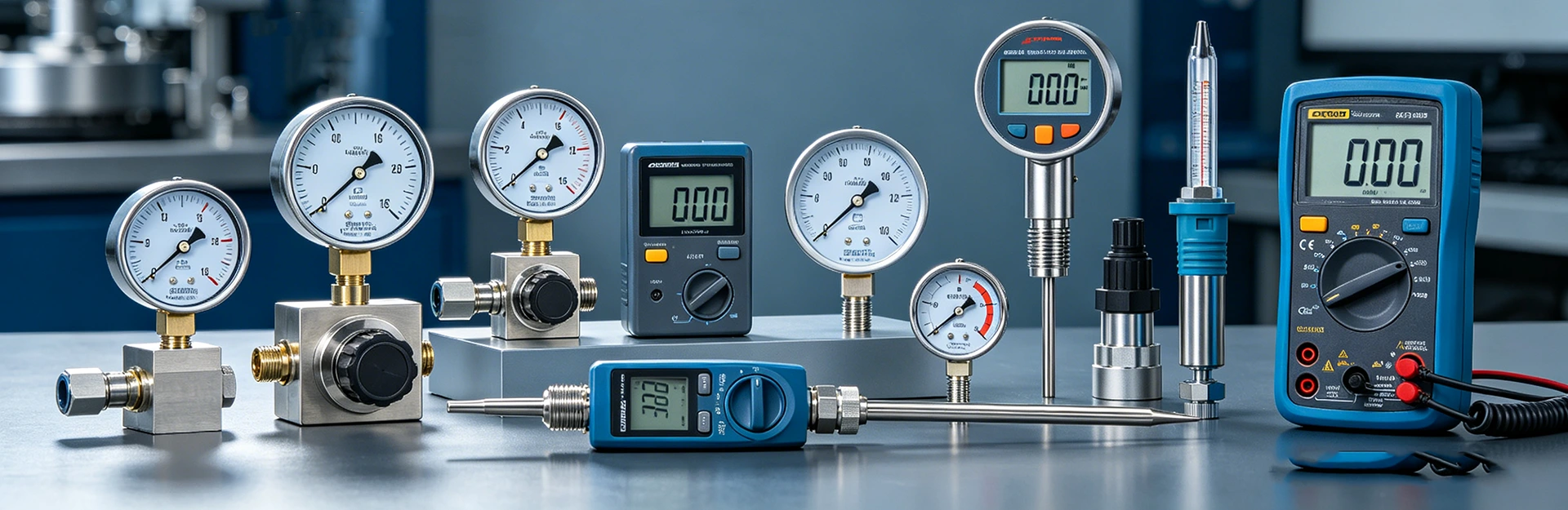
Physical Measuring Meter
Physical Measuring Meter: Precision Measurement for the Modern World
In today's demanding industrial and scientific environments, accurate and reliable measurement is not just a convenience—it's an absolute necessity. Whether in a research lab, a manufacturing facility, a quality control department, or an educational institution, professionals require tools that deliver consistent, trustworthy data. This is where a high-quality Physical Measuring Meter becomes an indispensable asset. At instruments-meters.net, we understand that precision is paramount, and our comprehensive range of meters is engineered to meet the most rigorous standards.
A Physical Measuring Meter is a sophisticated instrument designed to quantify various physical properties of materials and environments. These devices translate physical phenomena into readable, numerical data, enabling analysis, monitoring, and control. The applications are vast, spanning multiple industries including electronics, materials science, construction, environmental monitoring, and academic research.
**Core Technologies and Measurement Principles**
Modern Physical Measuring Meters utilize advanced sensor technologies and digital signal processing to achieve high accuracy. Common measurement principles include:
* **Electrical Measurement:** Utilizing probes to measure voltage, current, resistance, capacitance, and inductance.
* **Optical Measurement:** Employing lasers, LEDs, or other light sources to gauge distance, thickness, reflectance, or color.
* **Mechanical/Tactile Measurement:** Using precise probes or styli to measure surface profiles, roughness, or dimensional geometry.
* **Environmental Sensing:** Integrating sensors for temperature, humidity, pressure, sound level, light intensity, and air quality parameters.
* **Material Analysis:** Assessing properties like hardness, viscosity, conductivity, or magnetic field strength.
**Detailed Product Specifications and Parameters**
Selecting the right meter depends entirely on your specific application requirements. Below is a detailed breakdown of key parameters to consider, followed by a comparative table of some popular models available at instruments-meters.net.
**Key Specification Categories:**
1. **Measurement Type & Range:**
* Defines the specific physical quantity the meter measures (e.g., temperature, pressure, distance) and the minimum and maximum values it can accurately detect.
* Example: A thermocouple thermometer might have a range of -200°C to +1370°C.
2. **Accuracy & Resolution:**
* **Accuracy:** The degree of closeness between the measured value and the true value. Often expressed as a percentage of reading or a ± value (e.g., ±0.5% of reading ±2 digits).
* **Resolution:** The smallest change in the measured quantity that the meter can detect and display (e.g., 0.1°C, 0.01 mm).
3. **Sensor Type & Probe:**
* Specifies the technology used for sensing (e.g., RTD, thermocouple, piezoresistive, laser diode, ultrasonic transducer). The probe's design and material are critical for compatibility and durability.
4. **Display & User Interface:**
* Includes display type (LCD, LED, touchscreen), size, backlight, and the logic of menu navigation. A clear, user-friendly interface reduces operator error.
5. **Data Connectivity & Output:**
* Features like USB, Bluetooth, Wi-Fi, or analog outputs (4-20 mA, 0-10V) for data logging, transfer to PC/software, or integration into control systems.
6. **Power Supply & Battery Life:**
* Details whether the meter uses standard batteries (AA, AAA), rechargeable Li-ion packs, or AC power. Battery life under typical operating conditions is a key usability factor.
7. **Environmental Operating Conditions:**
* Specifies the temperature and humidity ranges within which the meter is guaranteed to perform to its stated specifications (e.g., 0°C to 50°C, 80% RH non-condensing).
8. **Physical Build & Durability:**
* Encompasses housing material (e.g., ABS plastic, aluminum alloy), ingress protection (IP) rating for dust/water resistance, and general robustness for field or lab use.
**Comparative Product Table**
The following table provides a snapshot of diverse Physical Measuring Meters offered by instruments-meters.net, highlighting their primary function and core specs.
| Model Series | Primary Measurement Function | Key Range Example | Typical Accuracy | Sensor Type | Key Feature |
| :--- | :--- | :--- | :--- | :--- | :--- |
| **IM-TH800** | Temperature & Humidity | Temp: -40°C to 80°C
RH: 0% to 100% | ±0.5°C, ±3% RH | Capacitive / Thermistor | Data logging, Graph display, Alarm settings | | **IM-DL150** | Laser Distance | 0.05m to 150m | ±1.5 mm | Class 2 Laser | Pythagoras function, Area/Volume calculation | | **IM-SL420** | Sound Level | 30 dB to 130 dB | ±1.5 dB | Electric Condenser Mic | A & C Weighting, Fast/Slow response, Max Hold | | **IM-MM500** | Multifunction (Elec.) | Voltage: 600V AC/DC
Resistance: 60MΩ | ±(0.5%+3 digits) | High-impedance Input | True RMS, CAT IV safety, NCV detection | | **IM-SR75** | Surface Roughness | Ra: 0.05μm - 10.0μm | ±5% | Diamond Stylus | Portable, Internal memory, PC software included | | **IM-LX200** | Lux / Light Intensity | 0.1 to 200,000 Lux | ±5% rdg ±10 digits
(<10,000 Lux) | Silicon Photodiode | Cosine correction, USB data export | **Frequently Asked Questions (FAQs) About Physical Measuring Meters** **Q: How often should I calibrate my Physical Measuring Meter?** **A:** Calibration frequency depends on usage intensity, environmental conditions, manufacturer recommendations, and quality standards your work must adhere to (e.g., ISO guidelines). For critical applications, annual calibration is a common baseline. For meters used in harsh conditions or dropped frequently, more frequent checks (semi-annually or quarterly) are advisable. instruments-meters.net provides calibration reminders and services for supported models. **Q: What does "True RMS" mean on a multimeter, and why is it important?** **A:** True RMS (Root Mean Square) indicates the meter can accurately measure the effective value of AC voltages and currents, regardless of whether the waveform is a perfect sine wave or a distorted one (e.g., from variable-speed drives, computers). A non-True RMS meter may give inaccurate readings on non-sinusoidal waveforms, leading to measurement errors in modern electrical systems. For professional diagnostic work, a True RMS meter is essential. **Q: Can I use one meter for multiple, very different measurement types?** **A:** While multifunction meters exist (like combo environment meters or advanced multimeters with temperature probes), there is often a trade-off between versatility and peak performance. A dedicated meter for a specific parameter (like a high-precision sound level meter or a specialized coating thickness gauge) will typically offer better accuracy, a more suitable range, and features optimized for that task. Evaluate your primary needs before opting for a jack-of-all-trades device. **Q: How do I choose between a laser distance meter and an ultrasonic one?** **A:** Laser distance meters are generally more precise over longer distances and are ideal for applications requiring high accuracy (e.g., construction layout, interior design). They need a solid, reflective target. Ultrasonic meters use sound waves, are less expensive, and can measure to soft or irregular surfaces where a laser dot might be hard to place, but they are less precise and can be affected by temperature, wind, or background noise. **Q: What is an IP Rating, and what IP rating do I need for my environment?** **A:** IP (Ingress Protection) rating defines a product's resistance to solid particles (first digit) and liquids (second digit). For example, IP54 means protection from dust ingress (5) and water splashes from any direction (4). A lab environment might only need IP20. For field use outdoors, IP65 (dust-tight and protected against low-pressure water jets) is a robust choice. Always match the IP rating to the environment's hazards. **Q: My meter has data logging. How do I transfer and analyze the data?** **A:** Most modern meters with logging capability come with proprietary or compatible software. Typically, you connect the meter to a computer via USB or wirelessly via Bluetooth. The software allows you to download the recorded data points, often with timestamps, and view them in tabular or graphical form. Many allow for export to universal formats like CSV or Excel for further analysis in other programs. instruments-meters.net provides dedicated software and driver support for its data-logging models. **Q: Why are the probes and sensors sometimes sold separately?** **A:** Different applications require different sensor types. For instance, measuring surface temperature, air temperature, and liquid temperature all need different probe designs (surface, penetration, immersion). Selling probes separately allows users to customize their Physical Measuring Meter kit for their specific tasks, ensuring optimal measurement accuracy and sensor longevity. Always ensure the probe is compatible with your meter's model and input specifications.
RH: 0% to 100% | ±0.5°C, ±3% RH | Capacitive / Thermistor | Data logging, Graph display, Alarm settings | | **IM-DL150** | Laser Distance | 0.05m to 150m | ±1.5 mm | Class 2 Laser | Pythagoras function, Area/Volume calculation | | **IM-SL420** | Sound Level | 30 dB to 130 dB | ±1.5 dB | Electric Condenser Mic | A & C Weighting, Fast/Slow response, Max Hold | | **IM-MM500** | Multifunction (Elec.) | Voltage: 600V AC/DC
Resistance: 60MΩ | ±(0.5%+3 digits) | High-impedance Input | True RMS, CAT IV safety, NCV detection | | **IM-SR75** | Surface Roughness | Ra: 0.05μm - 10.0μm | ±5% | Diamond Stylus | Portable, Internal memory, PC software included | | **IM-LX200** | Lux / Light Intensity | 0.1 to 200,000 Lux | ±5% rdg ±10 digits
(<10,000 Lux) | Silicon Photodiode | Cosine correction, USB data export | **Frequently Asked Questions (FAQs) About Physical Measuring Meters** **Q: How often should I calibrate my Physical Measuring Meter?** **A:** Calibration frequency depends on usage intensity, environmental conditions, manufacturer recommendations, and quality standards your work must adhere to (e.g., ISO guidelines). For critical applications, annual calibration is a common baseline. For meters used in harsh conditions or dropped frequently, more frequent checks (semi-annually or quarterly) are advisable. instruments-meters.net provides calibration reminders and services for supported models. **Q: What does "True RMS" mean on a multimeter, and why is it important?** **A:** True RMS (Root Mean Square) indicates the meter can accurately measure the effective value of AC voltages and currents, regardless of whether the waveform is a perfect sine wave or a distorted one (e.g., from variable-speed drives, computers). A non-True RMS meter may give inaccurate readings on non-sinusoidal waveforms, leading to measurement errors in modern electrical systems. For professional diagnostic work, a True RMS meter is essential. **Q: Can I use one meter for multiple, very different measurement types?** **A:** While multifunction meters exist (like combo environment meters or advanced multimeters with temperature probes), there is often a trade-off between versatility and peak performance. A dedicated meter for a specific parameter (like a high-precision sound level meter or a specialized coating thickness gauge) will typically offer better accuracy, a more suitable range, and features optimized for that task. Evaluate your primary needs before opting for a jack-of-all-trades device. **Q: How do I choose between a laser distance meter and an ultrasonic one?** **A:** Laser distance meters are generally more precise over longer distances and are ideal for applications requiring high accuracy (e.g., construction layout, interior design). They need a solid, reflective target. Ultrasonic meters use sound waves, are less expensive, and can measure to soft or irregular surfaces where a laser dot might be hard to place, but they are less precise and can be affected by temperature, wind, or background noise. **Q: What is an IP Rating, and what IP rating do I need for my environment?** **A:** IP (Ingress Protection) rating defines a product's resistance to solid particles (first digit) and liquids (second digit). For example, IP54 means protection from dust ingress (5) and water splashes from any direction (4). A lab environment might only need IP20. For field use outdoors, IP65 (dust-tight and protected against low-pressure water jets) is a robust choice. Always match the IP rating to the environment's hazards. **Q: My meter has data logging. How do I transfer and analyze the data?** **A:** Most modern meters with logging capability come with proprietary or compatible software. Typically, you connect the meter to a computer via USB or wirelessly via Bluetooth. The software allows you to download the recorded data points, often with timestamps, and view them in tabular or graphical form. Many allow for export to universal formats like CSV or Excel for further analysis in other programs. instruments-meters.net provides dedicated software and driver support for its data-logging models. **Q: Why are the probes and sensors sometimes sold separately?** **A:** Different applications require different sensor types. For instance, measuring surface temperature, air temperature, and liquid temperature all need different probe designs (surface, penetration, immersion). Selling probes separately allows users to customize their Physical Measuring Meter kit for their specific tasks, ensuring optimal measurement accuracy and sensor longevity. Always ensure the probe is compatible with your meter's model and input specifications.
- View as