
Residual Current Transformer in China for Modern Electrical Safety
2026-08-15
Every year, electrical faults claim lives and property—yet many remain preventable. In China, the demand for robust residual current transformers has surged as industries and homes adopt smarter, safer power systems. Enter Xiasen: a name quietly powering this shift with precision-engineered RCTs designed to detect even the faintest leakage currents. But what makes these components so critical in today’s grid? And how is Xiasen redefining safety standards across the country? Read on to uncover the technology and trust behind modern electrical protection.
Why Residual Current Transformers Are the Silent Guardians of China's Grid
In the sprawling network that powers homes, factories, and high-speed rail lines across China, a small component works around the clock without ever drawing attention to itself. Residual current transformers sit quietly inside distribution panels and substations, continuously comparing the current flowing out on a live conductor against what returns on the neutral. The moment a few milliamps go missing—leaking through worn insulation, a damp connection, or a human body—these devices trigger a breaker and cut the circuit. It is a job that demands absolute reliability, yet most people will never know one saved their life.
What makes these transformers especially critical for China's grid is the sheer speed and density of modern electrical load growth. In older neighborhoods, wiring was originally designed for lights and a handful of appliances; now it must support induction cookers, air conditioning, and electric vehicle chargers running simultaneously. That stress increases the chance of insulation breakdown. Residential and commercial installations rely on residual current protection to isolate faults before they escalate into fires. On a larger scale, industrial parks and data centers cannot afford even a momentary ground fault that could damage sensitive equipment or halt production, so engineers install residual current transformers at multiple levels for coordinated protection.
China's push toward renewable energy and smart grids adds another layer of complexity. Solar inverters and battery storage systems introduce DC components and high-frequency switching that can confuse poorly designed sensing equipment. A well-built residual current transformer must reject this noise while still catching true leakage currents. Utilities and electrical contractors increasingly specify units with wide frequency response and magnetic shielding, knowing that a false trip is just as costly as a missed fault. In this way, these silent guardians do more than prevent electric shock—they preserve the uptime and safety margin of one of the world's largest and fastest-evolving power systems.
From Factory Floors to High-Rise Towers: Where These Devices Earn Their Keep
Factory floors are not kind to electronics. Grease, metal dust, and constant vibration chew through consumer gear in weeks. The devices that survive here are built to be dropped, kicked, and sprayed down between shifts. Their screens stay legible under harsh fluorescent light, and their buttons work with gloved fingers. More than that, they keep production moving—scanning raw materials, logging torque settings, and flagging worn tooling before it snaps.
Climb a high-rise tower and the threats change. Wind gusts yank at your harness; narrow catwalks leave no room to fumble. Inspection tablets and handhelds used up top must be light enough to clip onto a belt, yet tough enough to shrug off a 10-meter tumble onto concrete. Battery life matters too, because there's no outlet on a crane rail. These tools document stress fractures, coordinate lift teams, and send real-time load data back to the ground crew.
In both settings, the common thread is trust. A device that fails mid-shift doesn't just slow things down—it can stall an assembly line or leave a crew blind at 40 stories. So they earn their keep by staying out of the way, working without complaint in heat, cold, dust, and rain.
The Chinese Standard That Changed the Game for Leakage Protection
For years, residual current devices (RCDs) were tuned almost exclusively to alternating current faults. That worked fine until electric vehicle charging brought direct current leakage into everyday residential and commercial circuits. The Chinese standard flipped this assumption by requiring protection that responds to smooth DC residual currents as well as traditional AC faults. Once it took effect, a charger that passed older IEC-based tests could still fail in the Chinese market unless it added a Type B or equivalent detection module.
The practical impact showed up quickly on the engineering side. Manufacturers had to replace simple AC leakage sensors with more complex fluxgate or hall-based current transformers, and they had to set trip thresholds that would catch DC faults without causing nuisance shutdowns from normal charging noise. Certification labs also updated their protocols, because the standard left little room for workarounds: if the protective device could not detect a smooth DC residual current within the stated time, the product simply did not ship.
What made this standard especially influential was its timing. China was already the world’s largest market for electric vehicles and charging piles, so suppliers across Europe, North America, and Asia had to redesign their leakage protection circuits to keep selling there. Over time, that redesign bled into global product lines, raising the baseline for EV charging safety even in regions where local codes had not yet caught up.
Sizing and Placing Residual Current Transformers Without the Guesswork
Getting the residual current transformer right starts with knowing the maximum expected leakage current under normal conditions. Pick a ratio that keeps that value somewhere in the middle of the transformer's range, not jammed at the low end where accuracy falls off. Oversizing a CT may seem safe, but it can mask small ground faults or produce a signal too weak for the relay to interpret reliably. Undersizing, on the other hand, risks saturation during a fault and can leave the protection scheme blind when it matters most.
Placement is just as important as ratio. The CT should sit where all phase conductors and the neutral pass through together, so that normal load currents cancel out. If you route only some conductors through the window, the CT sees a false residual current and may nuisance trip. Keep the CT away from heavy busbar runs and transformers that produce strong stray fields. Even a few centimeters of separation from a high-current conductor can reduce induced noise enough to stop spurious trips.
Finally, take burden and lead length into account. A long secondary wiring run adds impedance, which can push the CT out of its accuracy class. Use the manufacturer's burden curves and, when in doubt, shorten the loop or increase the conductor cross-section. Testing with a known low-level current injection after installation verifies that the relay trips at the intended threshold, removing the last bit of guesswork from the setup.
When Milliamps Matter: Testing and Troubleshooting in the Field
Chasing a flaky sensor loop in the field often comes down to reading the current draw at just the right moment. A handheld meter set to milliamps can reveal whether a 4–20 mA transmitter is actually pulling 3.8 mA at zero or drifting into 5 mA territory when the process hasn’t budged. The trick is not trusting a single snapshot—watch the reading while wiggling connectors, tapping the enclosure, or flexing the cable. Intermittent faults love to hide in those small current shifts.
One thing that trips people up is meter burden. Inserting a milliamp range in series with a loop adds a tiny resistance, and on a marginal circuit that extra voltage drop can push a transmitter into failure when it was working fine before you touched it. If the numbers look suspiciously low or dead, try a clamp-on mA adapter or measure across a known shunt instead. Also, keep an eye on the loop’s total resistance—power supply voltage, wiring length, and the meter itself all eat into the available headroom.
Field troubleshooting rarely rewards the neat textbook setup. Corroded terminals, water in a junction box, or a ground loop can skew milliamp readings by a few tenths—enough to make a control system respond erratically. Carry a small selection of precision resistors, a good set of test leads with sharp probes, and a can of contact cleaner. And when you finally catch that 2 mA drop on a rainy afternoon, note the weather in your log. Sometimes the environment is the real culprit.
Smart Grids, Smarter Protection: The Next Wave of Residual Current Monitoring
The rollout of digital substations and distributed energy resources is pushing residual current monitoring far beyond its electromechanical roots. Traditional RCDs trip on a threshold, but they cannot tell a degrading cable joint from a transient earth fault caused by inverter switching. The next generation of monitors samples residual current waveforms at high resolution, extracting harmonic signatures and phase relationships that reveal the nature of the leakage before it becomes dangerous. This turns a simple safety device into a sensing node that feeds condition-based maintenance platforms, allowing grid operators to schedule repairs during planned outages rather than reacting to nuisance trips.
In practice, that shift matters most where continuity of supply is non-negotiable. Electric vehicle charging hubs, hospital microgrids, and data centers experience frequent switching harmonics that can confuse legacy protection. Smarter residual current monitors apply edge-based pattern recognition to distinguish normal capacitive leakage from the slow, erratic rise of insulation breakdown. The result is fewer false disconnections and earlier detection of real faults, often weeks before a catastrophic failure. Instead of waiting for a threshold breach, the protection system now watches trends, learns from each feeder's normal signature, and acts only when the deviation is both persistent and risky.
FAQ
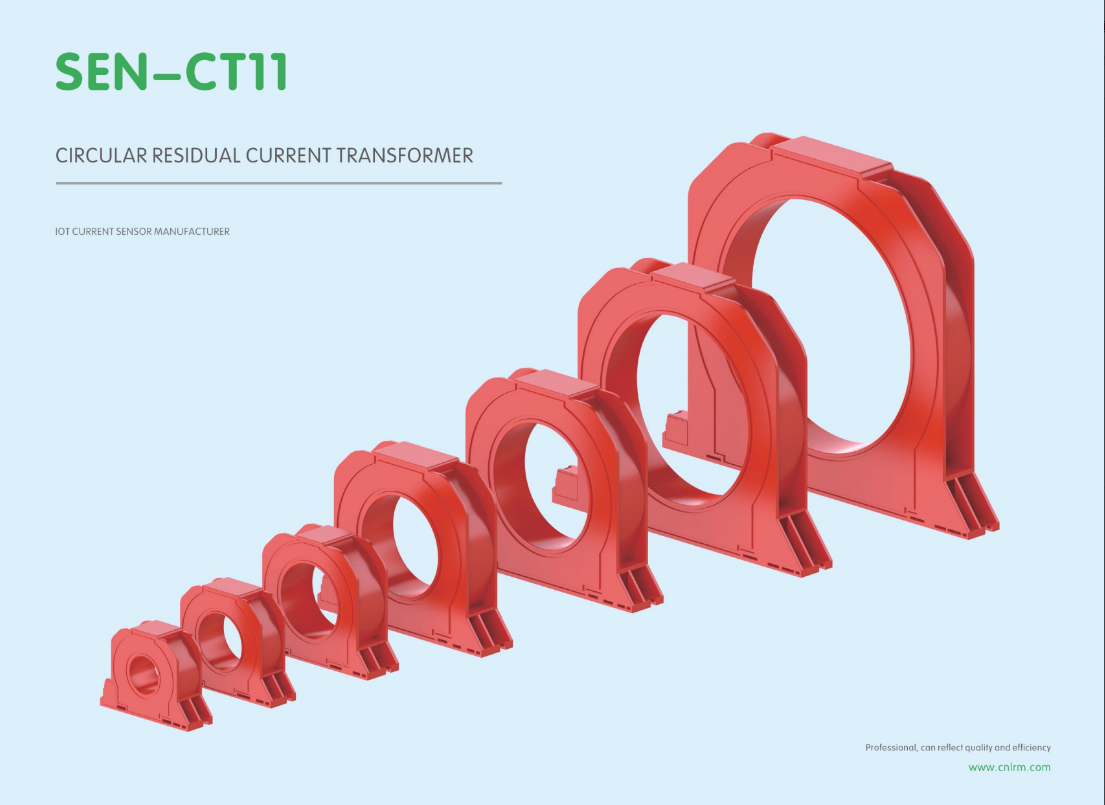
A residual current transformer is a current-sensing device that monitors the vector sum of currents flowing through all live conductors. In a healthy circuit that sum is zero; any imbalance indicates leakage current, often caused by insulation failure or accidental contact. In China’s rapidly expanding residential and commercial buildings, these devices are the backbone of earth leakage protection, feeding signals to relays or circuit breakers to disconnect power within milliseconds. This prevents electric shocks, fires, and equipment damage. Their compact size and high sensitivity make them indispensable in distribution boards, especially as Chinese wiring ages and the number of connected devices grows.
In a three-phase system, all three phase conductors and the neutral pass through the transformer’s magnetic core. Under normal conditions, the magnetic fluxes produced by the outgoing and returning currents cancel out, so the secondary winding sees no induced voltage. If leakage occurs somewhere downstream, the sum of the primary currents is no longer zero, producing a residual flux. This flux induces a small proportional voltage in the secondary winding, which the connected relay interprets as a fault. The toroidal core design ensures that even a few milliamps of imbalance can be detected reliably, which matters a lot in industrial plants across China.
Class A units are designed for sinusoidal alternating residual currents and are adequate for most standard residential and light commercial loads. Class B units handle a wider spectrum: pulsating direct currents, smooth direct currents, and high-frequency components often produced by variable-speed drives, EV chargers, or photovoltaic inverters. In China, the shift toward power electronics and renewable energy has made Class B increasingly common in industrial and public infrastructure. The core materials and shielding differ—Class B typically uses higher-grade magnetic cores and improved immunity to external fields. Selecting the wrong class can lead to nuisance tripping or failure to trip when a real fault occurs.
The primary reference is GB/T 20840 series, which aligns closely with IEC 61869 standards but includes local requirements for materials, marking, and environmental testing. For residual current protection specifically, GB 14287 and GB 16917 provide performance and compatibility criteria for connected relays and breakers. Manufacturers also need to comply with China Compulsory Certification rules when the transformer is part of a complete protection device. Testing typically covers accuracy class, thermal withstand, insulation resistance, and immunity to external magnetic fields. Many suppliers additionally test against the older JB/T 10635 for specialized industrial applications, ensuring dependable operation in harsh electrical environments.
Southern China’s hot, humid climate can accelerate insulation degradation and promote condensation inside enclosures, which may create surface leakage currents that the transformer misreads as faults. High humidity also corrodes terminals and connection points, raising contact resistance and distorting the residual current signal. To mitigate this, Chinese manufacturers often use epoxy-encapsulated cores, tropicalized windings, and stainless steel hardware. Derating is another consideration: in sustained temperatures above 40 degrees Celsius, the transformer’s accuracy can drift, so installers should choose a unit with a wider temperature class. Regular inspection of gaskets and cable entries helps keep moisture out and prevents false tripping during the rainy season.
EV charging stations in China rely on residual current transformers to provide the mandatory DC leakage protection required by GB/T 18487.1. Because chargers contain rectifiers and power conversion electronics, they can generate smooth DC fault currents that standard AC-only transformers cannot detect. Modern charging piles therefore integrate Class B residual current transformers or add a separate DC-sensitive module. The transformer continuously monitors the supply cable and the charging connector, disconnecting power if leakage exceeds safe limits. This is critical in outdoor and semi-outdoor installations where rain, cable wear, and connector damage raise the risk of electric shock. The device also helps meet fire safety requirements in underground parking garages.
Start with the maximum load current: the transformer’s rated primary current should be at least 125 percent of the circuit’s normal operating current to avoid saturation. Then match the residual operating current to the intended protection level—typically 30 mA for personal shock protection and 100 or 300 mA for fire prevention. Check the inner diameter to ensure all phase and neutral conductors pass through without crowding, because a tight fit can stress insulation. For Chinese homes with many electronic appliances, a Class A transformer is usually enough, but if a solar inverter or EV charger is present, a Class B unit is safer. Also confirm compatibility with the residual current relay’s input impedance and the distribution board’s mounting style.
Quarterly visual inspections should focus on signs of overheating, discoloration, or cracking in the encapsulation. Terminal connections need to be re-tightened at least once a year because thermal cycling can loosen screws and introduce contact resistance that degrades accuracy. Dust and conductive deposits on the core surface can create false leakage paths, so clean with a dry cloth and approved solvent—never water. In plants with heavy harmonic loads, periodic testing with a residual current injection kit verifies that the transformer still trips at the correct threshold. Replace any unit that shows insulation resistance below 1 megaohm at 500 V DC. Finally, keep a log of ambient conditions and nuisance trips; a pattern of humidity-related alarms may indicate the need for a tropicalized replacement.
Conclusion
Residual current transformers do not announce themselves, yet their role in China's modern electrical safety is hard to overstate. They sit inside distribution cabinets, switchgear, and metering panels, continuously comparing the current flowing out and returning through a circuit. A difference of just a few milliamps—often far below what a standard breaker would notice—can signal insulation breakdown, accidental contact, or moisture ingress. Across factory floors, high-rise residential towers, and sprawling commercial complexes, these devices provide the trip signal that disconnects power before a leakage current becomes a fire or a fatal shock. The national push toward stricter leakage protection, reflected in updated Chinese standards for residual current operated protective devices, has pushed manufacturers and installers to treat RCT selection as more than an afterthought. Core size, rated residual operating current, burden, and mounting location all influence whether the transformer will perform reliably over years of service.
Field work proves that guesswork fails quickly. Commissioning and routine testing often involve injecting known residual currents to confirm that the relay trips within the specified time and at the right threshold. Because real leakage can be intermittent or influenced by harmonics, technicians learn to look beyond a simple pass/fail result and check secondary wiring, grounding, and shielding. At the same time, China's evolving grid is bringing residual current monitoring into the digital fold. Smart breakers and distributed sensors now stream leakage data to building management platforms, enabling predictive maintenance and faster fault location. The next wave will likely see more adaptive thresholds, better rejection of nuisance tripping, and closer integration with renewable and electric vehicle charging infrastructure—keeping these silent guardians relevant as the grid grows more complex.
Contact Us
Contact Person: Liu Mengyang
Email: [email protected]
Tel/WhatsApp: 8618727589233
Website: https://www.cnlrm.com/en/