China V Grooving Machine Solutions: Advanced Precision for Modern Manufacturing
2026-11-02
Ask any sheet metal fabricator about V grooving, and they'll tell you the same thing: precision is everything. A fraction of a millimeter can mean the difference between a clean bend and costly scrap. That's why modern manufacturers are turning to China's V grooving machine solutions—and why JIAN MENG has become a name worth knowing. In this post, we'll break down what separates advanced V grooving technology from the rest, and how it's shaping the future of high-accuracy metalwork.
The Groove Geometry That Keeps Painted Surfaces Flawless
Tiny variations in groove depth and sidewall angle change how liquid paint flows across a surface. When a groove is cut too steep or too deep, coating tends to pool at the bottom or sag along the edges. A carefully tuned geometry—usually with a slightly tapered cross-section—lets the paint settle evenly, creating a uniform film that hides the underlying transition.
Sharp corners inside a groove are the enemy of long-term finish quality. They concentrate stress when the material expands or contracts, leading to micro-cracks that peel away over time. By rounding the groove’s internal edges to a specific radius, you distribute that stress, so the painted layer stays intact through temperature swings and mechanical flexing.
Some grooves include a subtle roughness on the walls, not visible to the eye but enough to give the coating a mechanical grip. This texture discourages air pockets from forming during application and gives the paint thousands of tiny anchoring points. The result is a surface that looks seamless to the touch, with no pinholes or adhesion failures even after repeated use.
Inside the Chinese V Groovers That Cut Stainless Without Discoloration
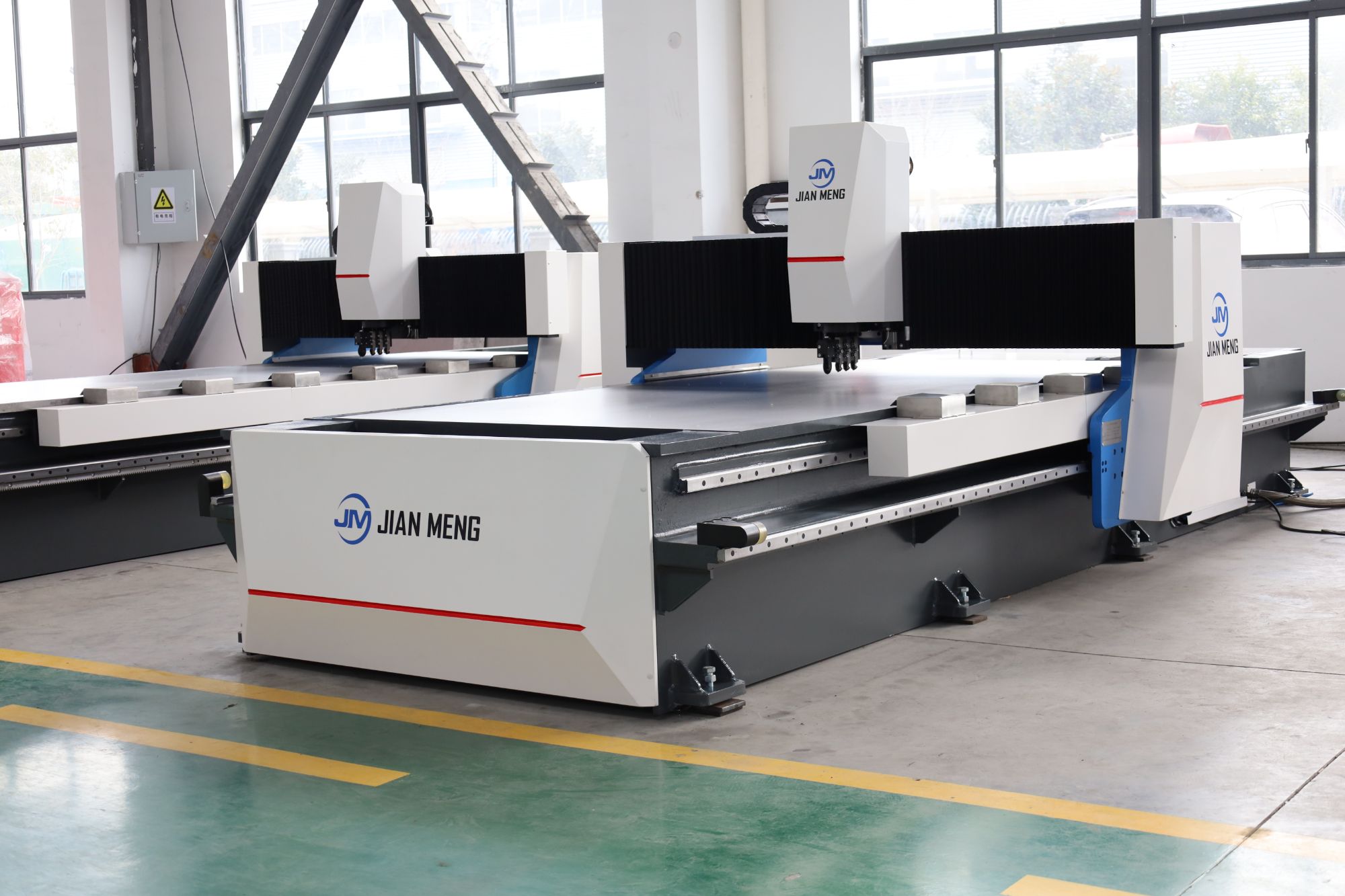
Walk the production floor of a busy fab shop in Guangdong and you'll notice the stainless V groovers don't rely on brute force or exotic alloys. The clean, oxide-free cuts come from keeping the cutting zone cool long before heat can build up. Most of these machines use a narrow carbide insert with a sharp positive rake, spinning just fast enough to peel out a thin ribbon of metal rather than rub it away. Paired with a low-friction coating, the edge stays cooler and the stainless never reaches the temperature where chromium reacts with air.
Coolant matters, but not in the way you might expect. Instead of flooding the groove and washing chips into the guides, a fine mist of mineral oil is aimed directly at the shear point. The oil evaporates on contact, hauling away heat while leaving the sheet dry enough to go straight to the press brake. Some shops add a compressed air line behind the cutter to blow the chip clear, so the same bit of metal doesn't get recut and generate a second round of friction.
What really separates the Chinese designs from older equipment is the feed control. The carriage movement is tied to spindle load, not just a fixed rate. When the tool enters a thicker section or a work-hardened edge, the feed backs off a fraction to keep cutting pressure constant. That subtle adjustment prevents dwell marks, the faint blue streaks that usually show up near the ends of a groove. It's the difference between a groove that looks machined and one that looks scorched.
Why Modern Shops Are Replacing Hand Finishing with Programmable Grooves
For decades, the quality of a groove was tied directly to the steadiness of the hand guiding the tool. A craftsman might spend years learning to read grain, adjust pressure mid-pass, and hide small inconsistencies. That kind of skill still has its place, but it doesn't scale. Modern shops are under pressure to produce more units in less time, and hand finishing becomes a bottleneck when every piece demands the same repetitive motion. Programmable grooving equipment removes that bottleneck by encoding the optimal tool path once and repeating it without fatigue or drift.
Consistency is only part of the story. Programmable systems let a shop switch from a simple straight groove to a curved or stepped profile in minutes, without retraining anyone or swapping out a set of specialized hand tools. Design changes happen in software, not on the workbench, which means prototypes and custom orders can move through the same line as standard products. The result is a quieter, safer floor where fewer workers are tied to repetitive arm work, and the grooves themselves come out identical from the first piece to the last.
A Look at the Frame Rigidity Behind Repeatable V Grooves
Repeatability in V groove work rarely starts at the cutting edge. It starts in the frame. A machine bed that flexes even a few microns under load turns a straight groove into a shallow arc, and the error repeats on every pass. Older cast iron bases with thick webbing often outperform lighter fabricated steel frames simply because they resist both bending and twisting moments without adding complexity to the control loop. When the spindle housing, rails, and workholding all bolt to a structure that stays put, the tool returns to the same coordinate with less correction.
Dynamic stiffness matters more than static stiffness once the spindle hits cutting speed. A frame with a high first natural frequency avoids the low-frequency wobble that causes scalloped groove walls. Damping is the other half: two machines can share the same static deflection numbers, yet the one with better internal damping—through polymer concrete fill or stress-relieved castings—leaves cleaner V geometry. Without that, vibration energy lingers long enough to widen the groove mouth by a few thousandths.
Thermal drift often gets overlooked in rigidity discussions. A spindle that grows a few microns as it warms tilts the entire cutting axis if the frame expands unevenly. Symmetric rib patterns and deliberate mass distribution keep the reference surfaces parallel through temperature swings. In practice, this means checking groove angle repeatability after a warm-up cycle, not just during the first cut of the day. Frames that blend mass, damping, and symmetric design hold the V profile from batch to batch without relying on constant offset adjustments.
From Elevator Interiors to Storefront Systems: One Groove Standard
A single groove profile might seem like a small detail, but it quietly ties together the vertical journey of an elevator and the horizontal pull of a shop entrance. The same extruded channel that holds brushed steel panels inside a lift can be repurposed to frame a glass storefront, guide a sliding door, or anchor a modular display wall. This isn't about forcing one component into every role; it's about recognizing that a well-designed groove offers enough tolerance, grip, and visual restraint to work across very different scales and environments.
In practice, that means a contractor can order the same aluminum track for an elevator cab retrofit and a retail facade upgrade without juggling separate inventories. The groove accepts standard gaskets, LED strips, or thin cladding with equal ease, so the finished look can shift from brushed industrial to minimalist glass without changing the core hardware. It reduces the learning curve on site and lets designers reuse a familiar detail they already trust from previous projects.
What makes this possible is a focus on tolerances and material behavior rather than decorative flourishes. The groove’s width and depth are tuned to hold panels securely under vibration and daily traffic, while still allowing thermal expansion and easy snap-in replacement. By keeping that one dimension consistent, a building’s circulation spaces and its commercial frontage no longer feel like separate systems—they become part of the same quiet, dependable language.
How Quick-Change Tooling Is Redefining Small-Batch V Grooving
Small-batch V grooving used to carry a hidden tax: every job change meant tearing down fixtures, swapping blades, and re-zeroing positions while the machine sat idle. Quick-change tooling removes most of that friction. Instead of treating setup as a fixed cost, shops can now move from one part number to the next in minutes, not hours, which makes short runs far less punishing on the schedule.
The real shift happens on the shop floor. Operators no longer need to chase offsets or hand-fit tooling for each new groove angle or material thickness. A repeatable clamping interface and preset cartridges let the same machine handle aluminum, stainless, or coated sheet without losing half a shift to trial cuts. That kind of flexibility matters when a customer wants fifty pieces, then five, then a slightly modified fifty.
The payoff isn't just speed. When changeover becomes predictable, the groove depth, angle, and edge finish stay consistent from batch to batch, which reduces scrap and rework. For job shops and prototype departments, that means small orders stop being a favor and start being a viable part of the business model.
FAQ
It lets fabricators create crisp, sharp bends with a much smaller radius than conventional press braking. By cutting a precise groove along the bend line, the remaining material thickness is reduced, so the metal folds cleanly without distortion or cracking. This is especially valuable for stainless steel elevator panels, architectural cladding, and decorative trim where a tight, elegant corner is non-negotiable.
Many modern units use CNC-controlled depth adjustment with real-time feedback. The cutting tool automatically compensates for thickness variations across the sheet, holding groove depth within a few hundredths of a millimeter. Operators can switch from 0.8 mm stainless to 3 mm aluminum without manual recalibration, which cuts setup time dramatically.
You'll find it heavily used in elevator manufacturing, kitchen equipment, HVAC ductwork, architectural metalwork, and premium signage. Any application where visible folded edges must look flawless or where bending thick plate into tight profiles would otherwise require excessive tonnage benefits from pre-grooving.
Pay attention to the frame rigidity and the drive system. A heavy-duty welded frame with stress-relieved construction prevents vibration during high-speed grooving. Linear guideways and ball screws on all axes, paired with a servo motor for the cutting head, deliver repeatable accuracy. Also check whether the control software supports automatic tool wear compensation and quick pattern changes.
Yes, and they do it very well. The key is selecting the right cutting insert geometry and adjusting the feed rate. Brass and copper are softer, so using a sharper positive rake angle insert prevents tearing and leaves a clean groove floor. Some Chinese machines include preset parameter libraries for non-ferrous alloys to simplify the transition.
Daily cleaning of the worktable and guide rails is essential because metal chips can cause premature wear. Weekly inspection of cutting tool holders for runout, along with lubrication of ball screws and linear bearings, helps maintain precision. Many manufacturers recommend recalibrating the depth sensor every few months or after any tool change.
A correctly dimensioned V groove removes only the material necessary to achieve the desired bend radius, leaving enough thickness to retain structural integrity. The bend itself becomes more localized, so there's less spring back and less residual stress compared to conventional air bending. However, over-grooving can weaken the part, so depth control is critical.
Faster servo-driven cutting heads, automatic tool changers, and multi-station worktables have made a big difference. Some systems now integrate with robotic loading and unloading to run lights-out. Additionally, improved CAM software allows nesting of multiple groove patterns on one sheet and simulates the cut path to avoid collisions before the cycle starts.
Conclusion
The growing reliance on precision V grooving across architectural metalwork has brought Chinese machine builders into focus for reasons that go beyond cost. Their groove geometry is now tuned to preserve paint and film finishes on thin aluminum and stainless sheets—edges stay sharp without tearing or micro-fractures that later show through coatings. On stainless, the cut path and tool pressure are managed tightly enough that heat discoloration along the groove line rarely appears, even on brushed or mirror stock. Underneath that consistency sits frame construction and damping that hold tool alignment over long runs; shops no longer chase offsets after every few sheets. Programmable depth and angle control has also displaced a lot of hand filing and deburring, which was the old bottleneck for clean returns on cladding and cabinet edges.
That same programmability makes one groove standard work across elevator interiors, storefront framing, signage backplates, and decorative wall systems, without retuning for each job. Quick-change toolholders and pre-set cassettes let a small batch switch from 0.8 mm stainless to 3 mm aluminum in minutes, so the machine stops being a high-volume-only asset. Shops that previously sent short runs to manual folding or subcontract folding now keep the work in-house, with geometry that matches the larger production runs. The result is a tighter fit between cut, bend, and coated surface—and fewer rejected panels from inconsistent groove depth. For modern manufacturing, that combination of frame rigidity, controlled heat input, and fast setup is becoming the practical definition of advanced V grooving, not just a catalog claim.
Contact Us
Contact Person: Jeanie
Email: [email protected]
Tel/WhatsApp: +86 19805122954
Website: https://www.jianmeng.com